Yes or No Wheel vs Coin Flip: Which Is Better for Decisions?
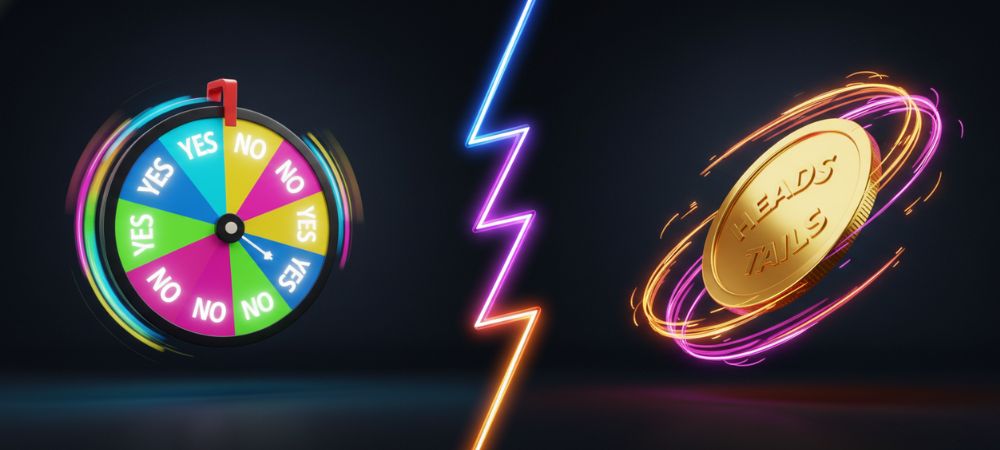
Stuck between yes and no? You are not alone. Most people reach for a coin or an online wheel when a decision feels too hard to make alone. Both tools work. But they do not work the same way.
The Yes or No Wheel gives you more control, more fun, and more options. A coin flip is faster but gives you less. If you need a quick one shot answer, flip a coin. If you want something that actually matches how you think and decide, the Yes or No Wheel wins easily.
What Is the Yes or No Wheel?
The Yes or No Wheel is an online spinning wheel built for yes or no decisions. You open the tool in a browser, spin it, and it lands on yes or no at random. Some versions also include a “maybe” option. You can often adjust the chances or add your own labels.
Want to understand how this tool works in detail? Read about what a Yes or No Wheel is and how it works for a full breakdown.
What Is a Coin Flip?
A coin flip is the oldest random decision tool on earth. You toss a physical coin — or use a digital coin flip app — and it lands on heads or tails. You pick which side means yes and which means no. Done. No setup. No learning curve. Just instant randomness.
The coin flip has been used for thousands of years to settle disputes and make quick calls.
Which One Is Faster?
Coin flip wins on speed. No question. You grab a coin, toss it, and you have an answer in under two seconds. Or you open a coin flip app and tap once.
The Yes or No Wheel takes a few more seconds. You load the page, spin the wheel, wait for it to stop. That is still fast. But if someone needs a decision in the next three seconds, the coin wins.
Speed is the only area where the coin flip has a real edge.
Which One Is More Customizable?
The Yes or No Wheel is not even close on this. You can change the labels. You can adjust how often yes or no shows up. Some wheels let you add a “maybe” section. You can even change colors and sounds on certain tools.
That maybe option is a big deal for decisions that are not purely binary. Life rarely gives you just two paths.
A coin flip gives you exactly two outcomes. That is it. No changes allowed. No maybe. No weighting. Just heads or tails.
Which One Feels More Fun and Engaging?
The Yes or No Wheel feels like a game. The animation, the spinning motion, the sound when it stops — all of it builds a small moment of excitement before the answer drops. That matters more than people think.
When something feels fun, people trust the result more. They are more likely to follow through on it.
This connects directly to the psychology of random choice and why humans enjoy handing control to something outside themselves.
A coin flip has no drama. It is over before you can feel anything. Some people prefer that. Most people, in group settings especially, want the experience — not just the result.
Which One Works Better in Groups?
The Yes or No Wheel is far better for groups. Everyone can see the wheel spinning on a shared screen. The buildup creates shared energy. People cheer, argue, laugh. It becomes a moment.
There are many fun ways to use a Yes or No Wheel at a party that turn group decisions into entertainment rather than arguments.
A coin flip in a group? Somebody always says they did not see it clearly. Or they question the toss. Or they just do not care about the result. It does not land the same way.
Which One Is Better for Daily Decisions?
This depends on what kind of decision you face. If you are deciding whether to hit snooze one more time, flip a coin. If you are deciding whether to message someone, try a new restaurant, take on a side project, or say yes to a social event — the Yes or No Wheel gives you a better experience.
The challenge of decision fatigue and small daily choices is real. Using a wheel regularly can help you outsource low stakes choices and save mental energy for the ones that matter.
You can also boost your daily productivity with randomness by using the wheel to break ties and stop overthinking.
Can a Yes or No Wheel Actually Help You Decide?
Yes. And the reason is not magic. When the wheel spins, you watch. When it slows down, you feel something. That feeling — relief, disappointment, resistance — tells you what you actually wanted before the wheel stopped.
Read more about whether a Yes or No Wheel can really help you make decisions to understand the psychology behind it.
That is not true with a coin flip. The flip is too fast. The emotional reaction has no time to form. You take the result and move on.
The Bias Problem: Is Either One Truly Random?
Physical coins are not perfectly fair. Studies show a coin landed heads up before a toss is slightly more likely to land heads again. Digital coin flips are random but only as good as the code behind them.
Coin flip bias research from Stanford and other institutions confirms that the 50/50 assumption is not always accurate in physical tosses.
The Yes or No Wheel, if built on a solid random number generator, is just as fair. And many wheels let you control the bias on purpose — if you want a 60 percent chance of yes and 40 percent chance of no, you can set that. That is a feature, not a flaw.
When Should You Use the Yes or No Wheel?
Use the Yes or No Wheel when:
- You want to enjoy the decision process, not just rush through it
- You are deciding with a group and want everyone involved
- You need a maybe option in addition to yes or no
- You want to adjust the probability of each outcome
- You are settling a fun argument like what to eat for dinner
The Yes or No Wheel is also ranked among the best online decision making tools for everyday use.
When Should You Use a Coin Flip?
Use a coin flip when:
- You need an answer in the next two seconds
- No phone or browser is available
- The decision is genuinely 50/50 and needs nothing more
- You want zero setup and zero drama
Coin flips are good for sports, simple bets, and quick personal choices where the result does not matter that much either way.
The Verdict: Yes or No Wheel Wins for Most People
The Yes or No Wheel is the better tool for almost every situation outside of pure speed. It is more fun. More flexible. Better for groups. And it creates a small emotional moment that actually helps you understand your own preference before the result shows.
The coin flip is a classic for a reason. It will never go away. But it was built for a world before smartphones. Today, a spinning wheel online gives you everything a coin gives you — and much more.
The Psychology Behind Why the Wheel Works
Here is something most people do not know. When you flip a coin or spin a wheel, your brain often reacts to the result emotionally before you consciously agree with it.
If the wheel lands on yes and you feel a slight disappointment — that is your gut telling you that you actually wanted no. If it lands on yes and you feel relief — that is your real preference surfacing.
The wheel does not just make the decision for you. It creates a moment of clarity. Your emotional reaction to the result reveals what you actually wanted all along.
That is the real value. Not the spin itself but what happens in your body the second you see the result. This connects to a broader idea covered in the psychology of random choice and why we love leaving it to fate.
Can a Yes or No Wheel Really Help You Make Better Decisions
For big life decisions — no. Use it for those and you are missing the point entirely. A yes or no wheel is not a replacement for real thinking.
But for the hundreds of small decisions that pile up every day? Yes. Absolutely. It saves mental energy. It stops overthinking. It helps you act instead of stall.
There is a full breakdown on this at can a yes or no wheel really help you make decisions — it is worth reading if you use this tool regularly.
How to Use a Yes or No Wheel — Step by Step
It is about as simple as a tool can get. Here is how it works:
- Go to the yes or no wheel page on this site
- Think of your question clearly before you spin — this matters more than people realize
- Click or tap the spin button
- Watch the wheel turn and stop
- Read the result and note your emotional reaction to it
- Use the result as your answer or as a signal for what you actually want
That last step is the important one. If you spin and feel wrong about the result — do not ignore that feeling. It is telling you something.
Best Online Yes or No Decision Tools in 2026
There are several tools out there for this. The most used ones include Yes or No Wheel Spin, Wheel of Names, Spin the Wheel, and dedicated yes or no spinners. Each has different features. Some allow custom labels. Some have sound effects. Some are mobile optimized.
For a quick comparison of the top options, best online decision making tools including yes or no wheel walks through each one and explains when to use which.
Final Thoughts
A yes or no wheel is not a magic tool. It is not going to change your life or make you a better decision maker on its own.
But it does one thing really well. It stops the loop. It gives your brain something external to respond to. And that emotional response to the result? That is often where the real answer was hiding all along.
Try it the next time you are stuck on something small. Spin the wheel. Notice how you feel when you see the result. You might be surprised how quickly you know what you actually want. Head to the yes or no wheel and give it a spin.