Everyone gets stuck. You stare at two options, your brain goes blank, and suddenly a small choice feels like it matters way too much. That moment is exactly why online decision-making tools exist.
The short answer? The Yes or No Wheel is one of the fastest free tools for simple decisions. But depending on what you need to decide, there are better tools for bigger or more complex choices. This post covers all of them, what they are good at, and when to use which one.
Why People Look for Decision-Making Tools Online
Decision fatigue is real. Researchers have found that humans make thousands of small decisions every day. By afternoon, your brain is already tired. So when you face even a simple choice like what to eat or which task to do first, it feels harder than it should.
Online tools take that mental weight off. They give you a push. Sometimes you just need something to pick for you so you can stop overthinking and start moving.
If you want to understand this deeper, read our post on Decision Fatigue: How to Stop Overthinking Small Daily Choices. It explains the science in plain words.
The Yes or No Wheel: Best Tool for Simple Decisions
When the choice is literally just yes or no, nothing beats the Yes or No Wheel. It is a spinning wheel with two options. You spin it, it lands, done. No thinking needed.
What makes it useful is the speed. There is no setup. No account. No form to fill. You land on the page and spin.
But here is something interesting. Most people who use a spin wheel do not actually follow the result every time. They use the spin to reveal what they already feel inside. If it lands on “yes” and your gut sinks, you already knew the answer was no.
That reaction is a decision-making trick on its own. The wheel becomes a mirror for your real feelings. That is honestly one of the smartest ways to use it.
Want to know more about how this tool works? Check out What Is a Yes or No Wheel? How It Works and Best Use Cases for a full breakdown.
Yes or No Wheel vs Coin Flip: Which One Wins?
Both are fast. Both are free. But they feel different to use.
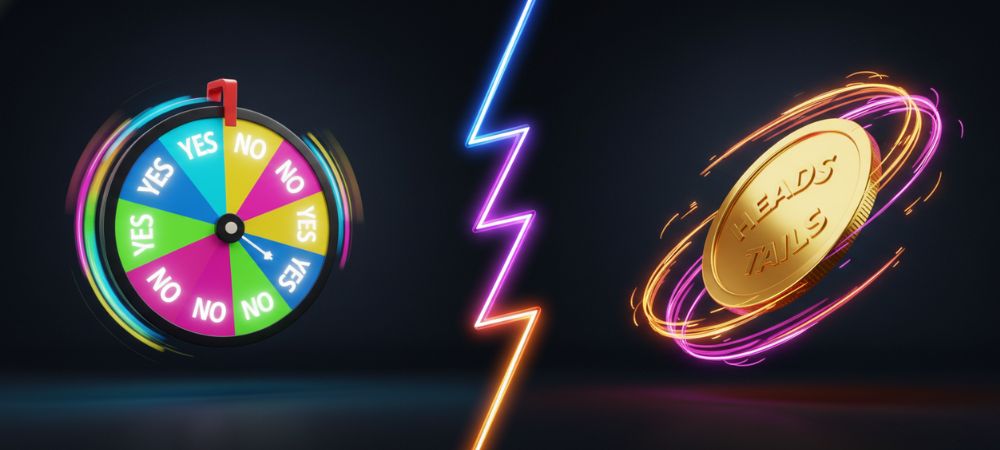
A coin flip gives you a random 50/50 result with zero visual. The Yes or No Wheel gives you the same result but you watch it happen. That watching part matters. The spin builds a tiny moment of suspense which makes your emotional reaction clearer.
For pure randomness with no emotion needed, a coin flip is fine. But for decisions where your gut matters, the wheel wins because of the reaction it creates in you during the spin.
Read the full breakdown in Yes or No Wheel vs Coin Flip: Which Is Better for Decisions? to understand both tools side by side.
Best Free Decision-Making Tools for Everyday Use
1. Yes or No Wheel Spin
Visit our homepage yesornowheelspin.com. Spin the wheel. Get your answer. Great for yes/no questions, small daily choices, and fun group games.
2. Wheel of Names
Wheelofnames.com lets you add custom names or options and spin a colorful wheel. Great for picking who goes first, choosing a restaurant, or any group decision with more than two options.
3. Random.org Decision Tool
Random.org uses atmospheric noise to generate true randomness. Much more random than your phone or computer. Use it when fairness matters or when you need to pick from a list with zero bias.
4. Decision Matrix Generator
A decision matrix helps when you have multiple options and multiple things to compare. You score each option on each factor and see which one wins mathematically. Mindtools.com has a free template that is easy to follow.
5. Pros and Cons List Tools
A simple pros and cons list is still one of the most effective tools ever created. Procon.io is a clean free web tool that formats this for you quickly. Better than scribbling on paper and easier to think through clearly.
6. Flip a Coin Online
Just Google “flip a coin” and Google itself shows you a coin. Or visit Flipsimu.com for a proper animated flip. Best for true 50/50 scenarios with no emotional weight needed.
7. This or That Generator
Some sites generate random “this or that” pairs for fun decisions or creative inspiration. Great when you are bored and need something to kickstart a choice or a game.
When to Use a Random Decision Tool and When Not To
Random tools work well for low-stakes decisions. What to eat. Which movie to watch. Who goes first in a game. Which task to start with. These are all perfect use cases.
But random tools are a bad idea for high-stakes choices. Quitting your job, ending a relationship, moving cities. These need real thought, conversations, and sometimes professional advice. A spinning wheel cannot and should not replace that.
The rule is simple. If the decision is reversible, use a tool. If it is not reversible, think harder.
There is a whole interesting side to using randomness for productivity though. Read How to Use Randomness to Boost Your Daily Productivity for more on this.
Can a Yes or No Wheel Actually Help You Make Better Decisions?
Yes. Not because it thinks for you. But because it removes hesitation.
When you have been going back and forth for too long, momentum is the problem. You need a nudge. The wheel gives that nudge instantly. And often, once you see the result, your body reacts. That reaction is data. Use it.
Research in behavioral psychology shows that the act of committing to a random outcome helps people stop second-guessing. Even if you override it, the process of spinning forces you to confront the decision rather than delay it.
If you are curious about the psychology behind this, The Psychology of Random Choice: Why We Love Leaving It to Fate is a good read.
Fun Ways to Use Decision Tools Beyond Everyday Choices
Decision tools are not just for serious stuff. They are genuinely fun in social settings.
You can use the Yes or No Wheel to settle arguments at the dinner table about where to order from. You can use a name wheel at parties to pick who gets the last slice of pizza. Random tools make group decisions feel fair and add a little excitement.
Check out Ten Fun Ways to Use a Yes or No Wheel at Your Next Party for creative ideas that actually make gatherings more fun.
And if the group cannot agree on dinner, How to Settle Any Argument Over What to Eat for Dinner has you covered too.
What to Do When You Are Not Ready to Decide at All
Sometimes the answer really is “maybe.” Not every decision needs a forced yes or no right now. Uncertainty is not always a bad thing.
If you feel genuine uncertainty, it might be worth reading The Science Behind the Maybe: When to Embrace Uncertainty. That post argues that sitting with uncertainty is sometimes smarter than rushing a decision.
Opinion: Which Decision-Making Tool Is Actually the Best?
After thinking through all the options, the Yes or No Wheel still wins for most everyday situations. Here is why.
It is instant. It is visual. It is free. And that gut reaction you feel during the spin tells you more about what you really want than any pros and cons list ever could.
That said, a decision matrix beats everything else when the choice involves multiple factors and real stakes. Do not spin a wheel to pick your career. But for 90% of the small daily decisions that slow you down? Spin the wheel. Trust your gut. Move on.
The best tool is the one that actually makes you decide. Not the most complex. Not the fanciest. The one that gets you unstuck fast.